
From Child Labour to Childhood: The Victorian Children’s Paintings at Llanelly House
September 1st 2026
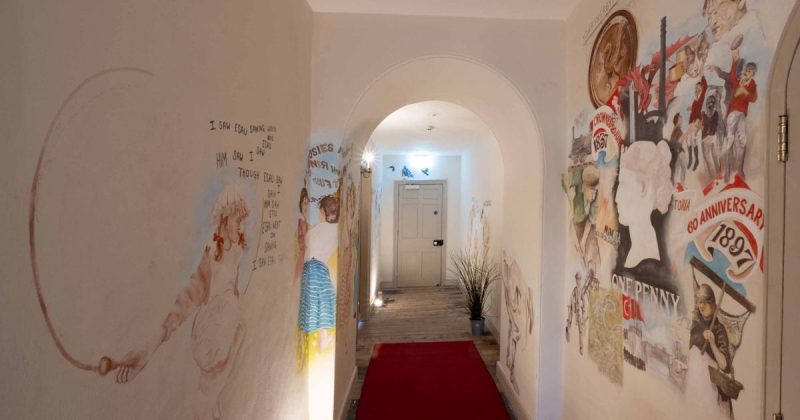
A journey through the paintings on the top floor of Llanelly House reveals a remarkable story of change. These Victorian artworks do more than capture scenes of childhood; they illustrate one of the most significant social transformations in British history, from children as workers to children as pupils and playmates. For the mural project at Llanelly House, we chose Beeck paint in 1-litre pots, which proved to be an excellent solution for working on the historic lime-plastered walls. The specialised mineral paint was particularly well suited to the conservation requirements of a listed building, providing compatibility with traditional lime surfaces while maintaining the breathability of the plaster. The powdered pigments mixed easily into the ready-to-use paint, allowing a wide range of subtle tones and colour variations to be achieved with consistency and accuracy. This flexibility was invaluable in creating the desired visual effect throughout the artwork. The finished murals have been extremely well received by visitors. Based on our experience, we would confidently recommend Beeck paint to artists, conservators and heritage professionals undertaking decorative painting projects within listed buildings, especially in conservation settings involving lime-plastered walls.
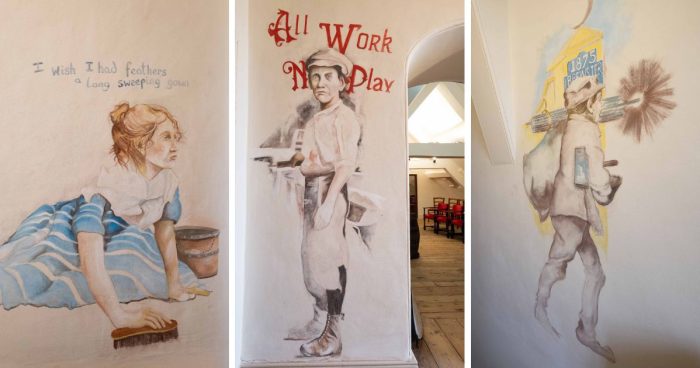
Children at work
At the beginning of the collection, the paintings depict the harsh reality faced by many working-class children during the Industrial Revolution. Young boys and girls are shown undertaking demanding and often dangerous occupations as chimney sweeps, maids, factory workers and miners. For many Victorian families, children’s wages were essential for survival, and work began at an age that we would now find unimaginable.
Among the most poignant stories connected to this period is that of George Brewster, a young chimney sweep whose tragic death became a catalyst for reform. In 1875, George became trapped while cleaning a chimney and died shortly after being rescued. His death shocked the nation and highlighted the continued exploitation of children in dangerous trades, helping to spur Parliament into strengthening legislation against the use of child chimney sweeps.
The paintings remind us that Victorian working conditions could be brutal. Children often worked long hours in cramped, dark and difficult environments. Many suffered from respiratory diseases, deformities, injuries and chronic illnesses caused by poor working conditions. For some, like George Brewster, the consequences were fatal. The Industrial Revolution brought economic growth, but it also exposed thousands of children to extreme hardship.
Gradually, attitudes began to change. Reformers, politicians and campaigners argued that children deserved education rather than exploitation. A major turning point came with the Elementary Education Act of 1870, often known as Forster’s Education Act. This landmark legislation established a national framework for elementary education and created local school boards to provide schooling where places were lacking. Compulsory attendance followed through later education acts, with school attendance for children aged five to ten becoming mandatory by 1880, and the leaving age later rising to eleven in 1893. Despite these advances, many poorer families still struggled to keep their children in school because they relied on the income their children could earn.
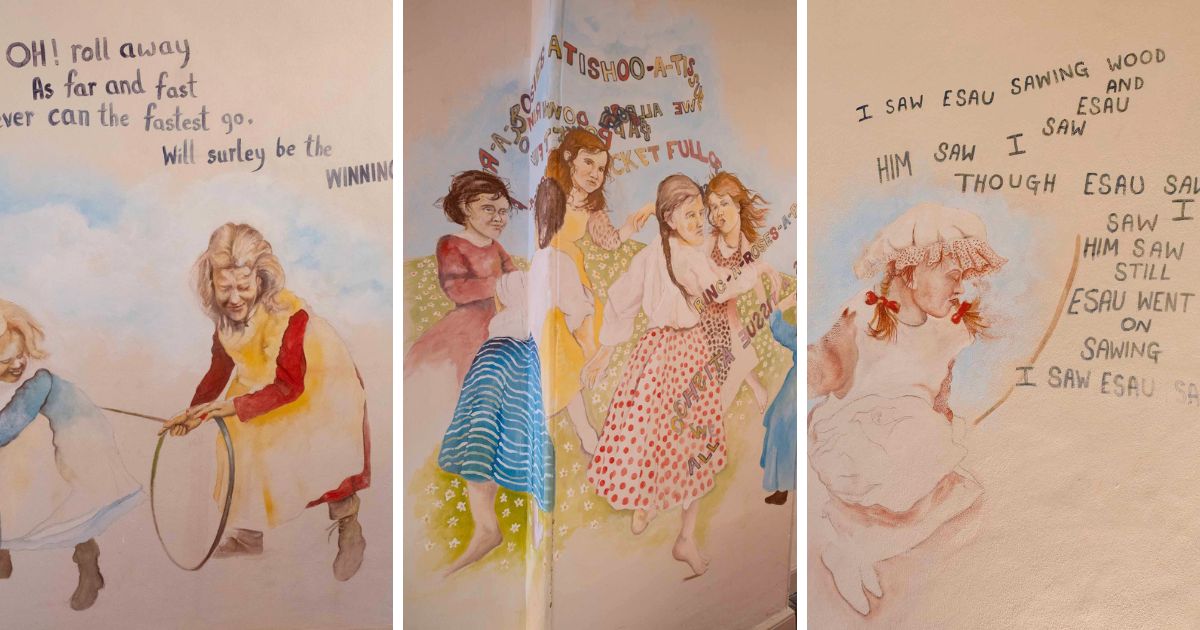
Girls Playing
As visitors move through the paintings, the subject matter changes dramatically. The scenes of labour give way to images of learning, recreation and childhood. Instead of working in mines or factories, children are shown enjoying leisure time with friends in the school yard. The transformation reflects a growing belief that childhood should be a period of education and development rather than relentless labour.
The arrangement of the paintings in the hallway also reflects Victorian society. Boys and girls are displayed on opposite sides, illustrating the period’s expectation that the sexes were often educated and socialised separately.
On the girls’ side, children can be seen enjoying activities such as hoop rolling, skipping rope and hopscotch. They sing nursery rhymes, play together and engage in games that foster friendships and community. These scenes celebrate a newfound opportunity for girls to experience childhood beyond domestic and industrial work.
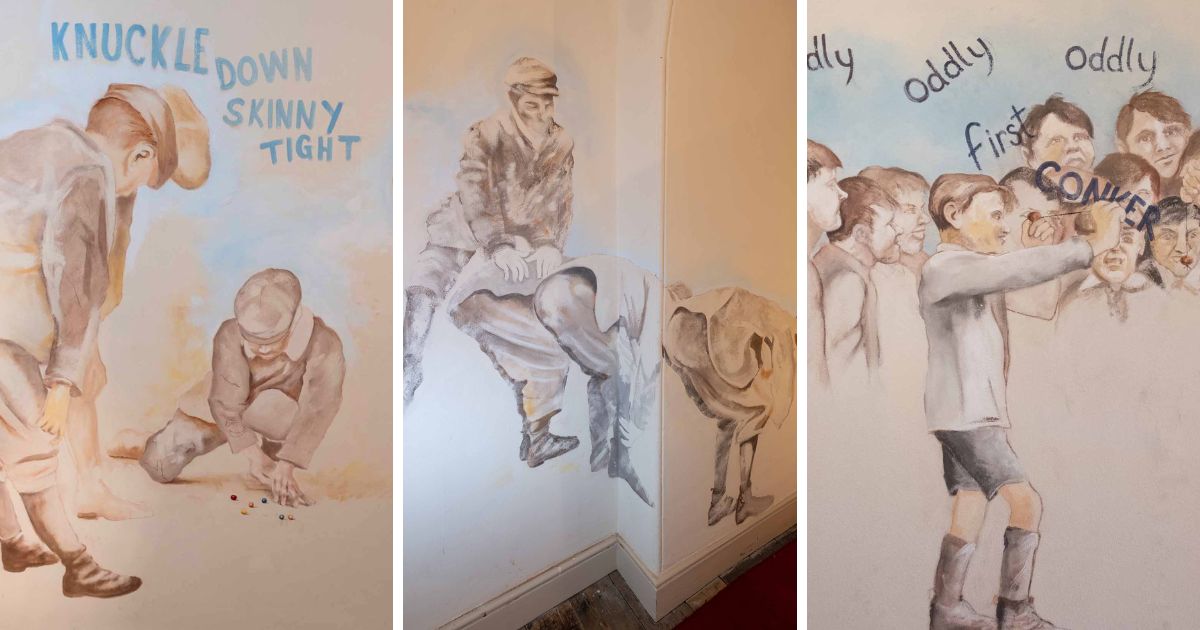
Boys Playing
Across the hallway, the boys gather to play marbles, battle with conkers and engage in energetic games such as leapfrog. Yet even within these playful pursuits, reminders of the working world remain. Many everyday phrases and customs originated in games that taught skills valued in both work and life. One such example is the expression “knuckle down”, which comes from the game of marbles, where players placed their knuckles on the ground to take a careful shot. Today, the phrase survives as a reminder to focus and work hard, linking childhood play with the values of discipline and perseverance.
Together, the Victorian children’s paintings at Llanelly House tell a powerful story of social progress. They chart the journey from an era when children laboured in dangerous workplaces to one in which education and play became recognised as essential parts of growing up. Through these artworks, visitors gain not only a glimpse of Victorian childhood but also an appreciation of the reforms and sacrifices that helped shape the rights and opportunities enjoyed by children today.
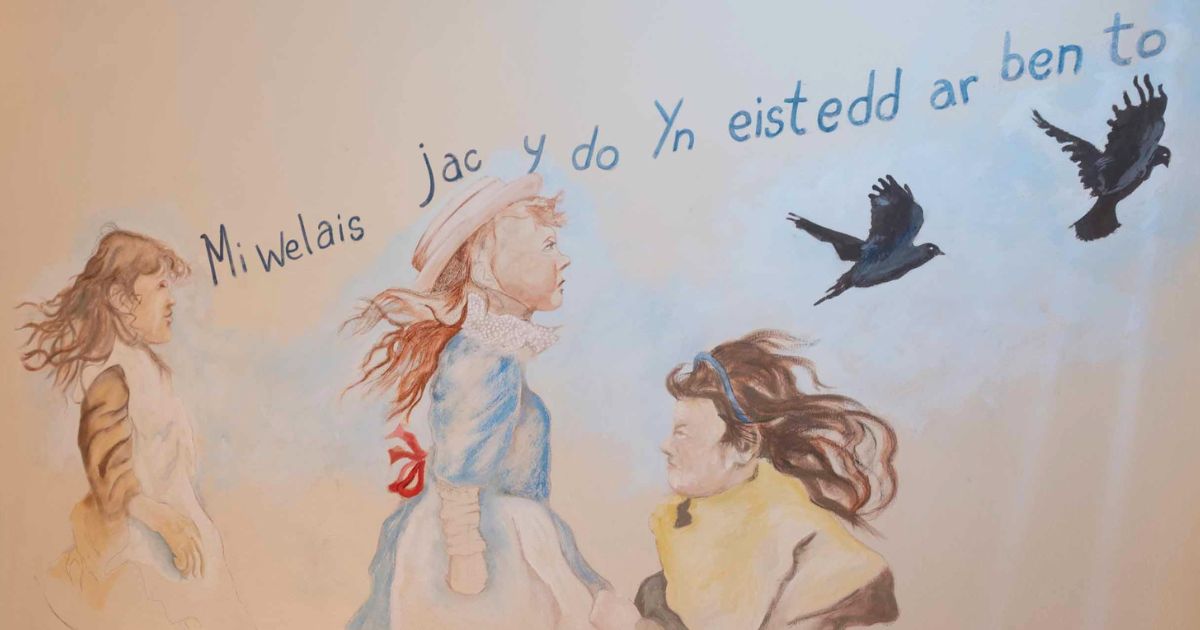
Mi Welais Jac y do, a Welsh Rhyme
The painting in the middle of the hallway symbolising aspects of Victorian Llanelli brings together many of the key events, industries and cultural icons that shaped the town during the nineteenth century.
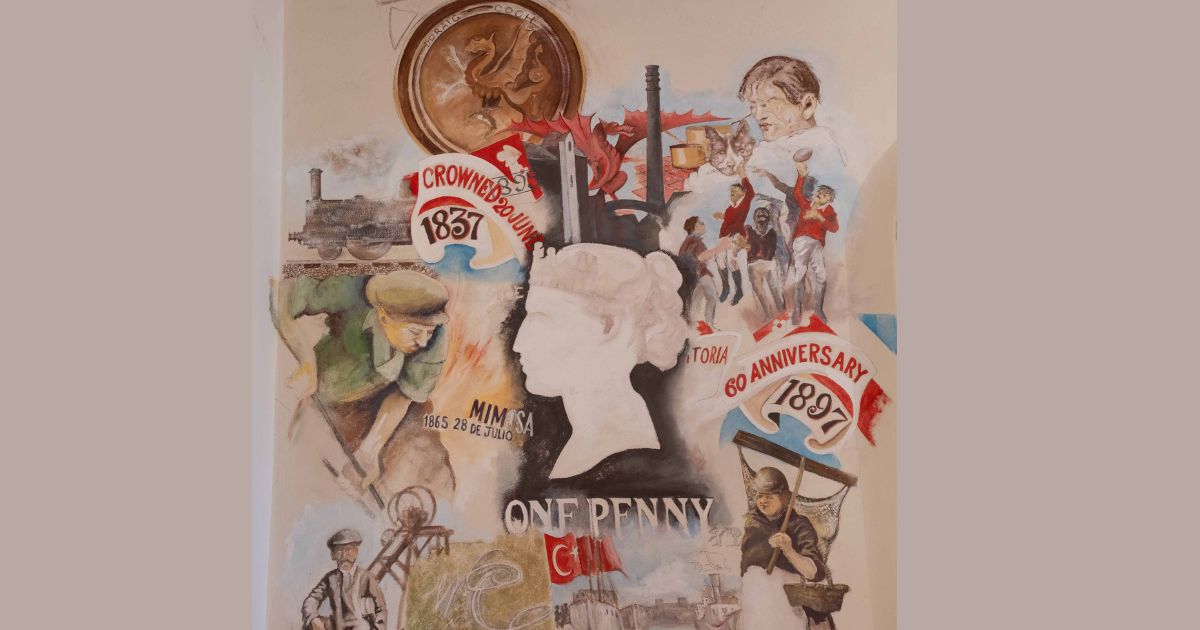
A celebration of Victorian Llanelli
On the top left is the steam train, commemorating the arrival of the railway and the visit of the renowned engineer Isambard Kingdom Brunel, whose work helped connect Llanelli to the wider railway network and ultimately provided a link between London and West Wales. The painting also acknowledges the town’s industrial growth through references to Felinfoel Brewery, established by David John in 1878, and the flourishing tinplate industry, represented by the man in green overalls and the iconic Sosban Fach, a symbol closely associated with Llanelli’s manufacturing heritage and later its rugby culture. Welsh identity is celebrated through the Ddraig Goch (Red Dragon), inspired by the 1895 Eisteddfod Chair, while the Mimosa recalls the famous 1865 voyage that carried the first Welsh settlers to Patagonia, Argentina. The town’s coal industry is represented by the figure with the spade, reflecting the importance of mining to the local economy, while the initials W.C. honour William Chambers, founder of Llanelli Pottery in 1840. The inclusion of the Turkish flag references the dockworkers who earned the nickname “Turks” after unloading Turkish ships during a period of industrial dispute. Finally, the cockle woman pays tribute to the generations of women who worked in the cockle-picking industry on the Burry Inlet, an occupation that provided a vital source of income and became an important part of Llanelli’s social and economic history. Together, these symbols create a vivid visual narrative of a town transformed by industry, enterprise, migration and Welsh cultural pride during the Victorian era.
We would like to extend our sincere thanks to William Reimnitz for his creativity, historical research, time and expertise throughout this project. Thank you to Gary Shinner for photographing this project. As valued members of both the Llanelli Art Society and the Llanelli Photographic Society, their knowledge, enthusiasm and support have been greatly appreciated. This project has helped to celebrate and preserve the history and heritage of Llanelli for future generations.